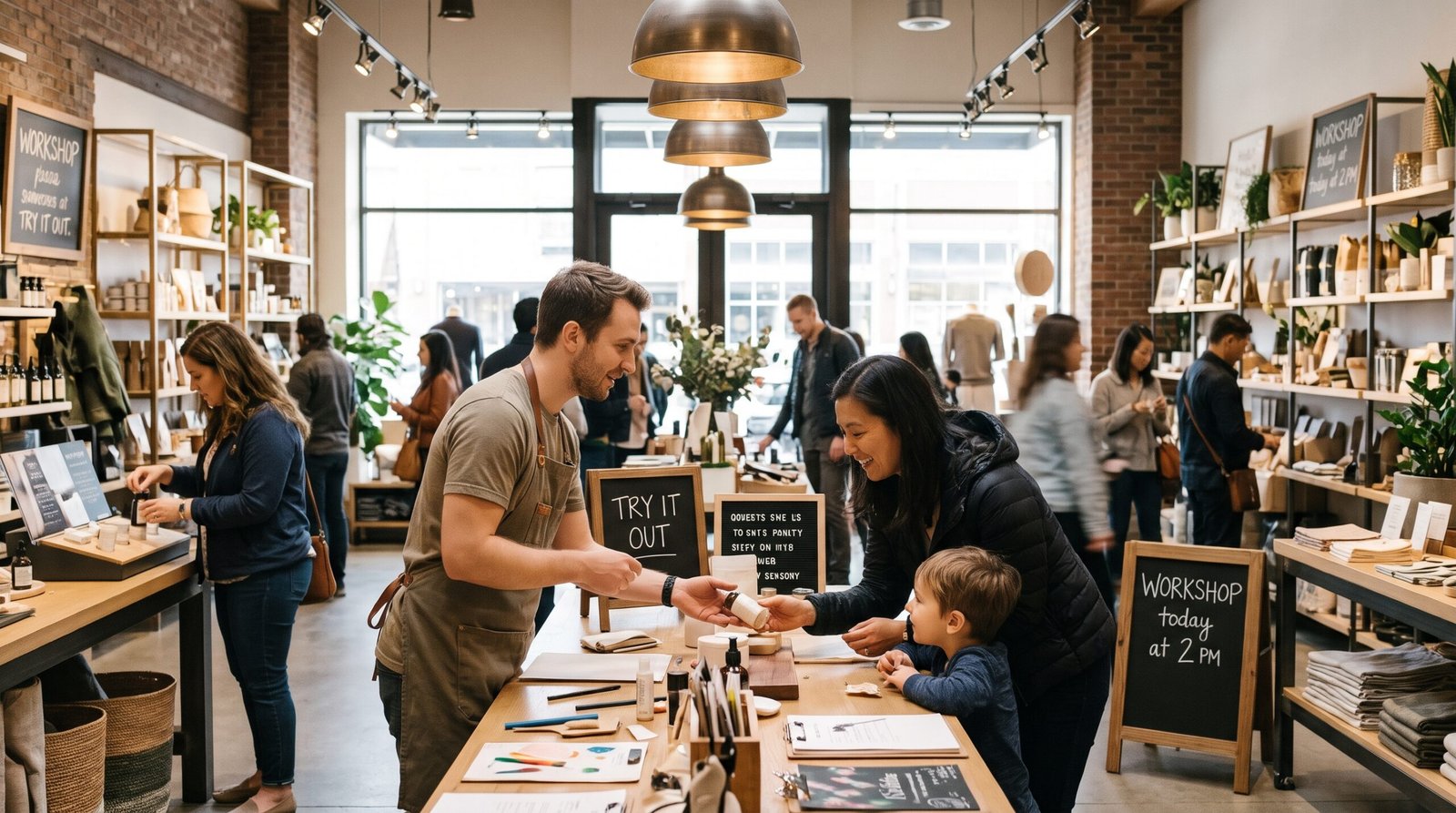
Every brick and mortar store experience starts at the front door, and that’s exactly where I spend a strange amount of my working life, standing a few steps inside and watching how people walk in. Honestly, what they buy matters less to me than what they do in the first ten seconds. Do they slow down or speed up? Maybe they look up, glance left, or reach for their phone. Some touch something right away, while others don’t touch anything at all. Those first few seconds tell me more about the store than any sales report, because that’s when the shopper decides, mostly without knowing it, whether the place is worth their time.
After many years in this work, I have sat through every retail panic. Stores were supposedly dying when online marketplaces took off, then dying again during lockdowns, and once more every time a big chain announced closures. Even so, the stores I work with keep opening locations, keep remodeling, and keep asking me the same question in different words: how do we make people want to come here?
This article is my honest answer. Rather than a trend list, it’s what I’ve seen work on real sales floors, backed by the research I point clients to when they want proof before they spend money.
The Brick and Mortar Store Experience Isn’t Losing. It’s Being Asked a Harder Question.
Let’s start with the numbers, because they’re usually not what people expect. According to the U.S. Census Bureau’s quarterly retail report, ecommerce accounted for about 17 percent of total U.S. retail sales in the second quarter of 2026. Online is clearly growing faster. However, flip that number around and you see that the vast majority of retail spending still happens through physical channels.
In other words, the store didn’t lose its job. Its job changed. Years ago a shop only had to stock the product and open the doors. Today, by contrast, the shopper could buy almost anything from their couch, so the store has to answer a harder question every single day: why should I come here instead?
The Halo Effect Changes the Conversation
There’s another piece of research I bring to almost every first meeting. The ICSC Halo Effect III report found that opening a store lifts online sales in the surrounding trade area by an average of 6.9 percent in the weeks after opening. For emerging direct to consumer brands, that lift is roughly twice as large. On the other hand, closing a store cuts online sales in that same area by about 11.5 percent.
When I share that, the conversation in the room changes. Suddenly the store stops being a cost center that competes with the website. Instead, it becomes the thing that makes the website work. That’s why a better brick and mortar store experience isn’t a nice extra. In fact, it’s one of the most practical growth levers a retailer has.
What a Brick and Mortar Store Experience Actually Means
People hear “experience” and picture confetti walls, selfie mirrors, and a DJ booth by the fitting rooms. Frankly, that’s a narrow and expensive way to think about it.
When I talk about a brick and mortar store experience, I mean the sum of everything a person feels, notices, and does from the moment they see your storefront to the moment they leave, plus what they remember the next day. That includes:
- How easy it is to understand the space when you walk in
- How the place smells, sounds, and feels underfoot
- Whether you can touch, test, and try things freely
- How staff treat you, and whether they actually know anything
- How long you wait to pay
- Whether the store connects to what you saw online
- Whether you’d tell a friend about it
Notice that most of these aren’t about technology or spectacle. Rather, they’re about removing doubt and adding confidence. The most memorable stores I’ve worked in rarely felt like attractions. Instead, they felt like places where buying the right thing was easy and a little bit enjoyable.
Why Efficiency Comes First in a Brick and Mortar Store Experience
This is the part that surprises clients who come to me asking for “something Instagrammable.”
JLL ran a study called Shifting Priorities in Retail Design, and the results are blunt. JLL’s research surveyed more than 2,000 adults across 15 countries and found that 53 percent of consumers say their main goal is simply to get what they need efficiently, even if that means less brand experience.
Still, I don’t read that as shoppers rejecting experience. On the contrary, I read it as shoppers telling us what experience means to them. A store that wastes their time can’t deliver a good brick and mortar store experience, no matter how pretty the lighting is. Clarity is the foundation, and delight sits on top of it.
Start With the Boring Work
In practice, that means I almost always begin a project with the unglamorous questions:
- Can a first time visitor find the three most popular categories without asking?
- Are prices visible without picking up every item?
- Is there a clear path from entrance to checkout that doesn’t feel like a maze?
- Do the signs use the words shoppers use, or the words the buying team uses?
That last one catches nearly everyone. For example, I once walked a store where the main signage said “Lifestyle Solutions.” Nobody knew what it meant. So we changed it to “Kitchen and Home,” and as a result that section started pulling traffic it had never seen before. There were no new fixtures, just honest words.
Design the First Fifteen Feet of Your Brick and Mortar Store Experience
Retail designers talk about the “decompression zone,” the first stretch of floor inside the entrance where people are still adjusting from the street to the store. At that point their eyes are adjusting to the light, their pace is slowing, and their brain is sorting out where they are. Consequently, anything you put right at the door usually gets ignored, because shoppers simply aren’t ready to see it yet.
My rule is simple. Keep that zone open and calm, and use it to orient people rather than sell to them.
Four Ways to Fix the Entrance
- Give them a clear sightline. From the entrance, a shopper should be able to see deep into the store and spot at least one strong focal point, such as a feature wall, a lit display, or a clearly marked service counter. Sightlines invite people in, whereas tall clutter at the front pushes them back out.
- Let the right side work for you. In many markets, most shoppers naturally drift to the right after entering. For that reason, I place the first real product story there, usually something seasonal or new that rewards the person for stepping in.
- Slow the pace on purpose. Changes in flooring, a shift in lighting temperature, or a table placed slightly into the walking path all gently slow people down. Slower shoppers notice more, and in turn, noticing more leads to buying more.
- Put a human in view. Not hovering at the door, but visible. A staff member who looks up, smiles, and goes back to work tells a shopper that help exists without forcing it on them.
Best of all, this part of the brick and mortar store experience costs nothing extra to fix. Most stores just need to clear the entrance and stop treating the doorway as a place to stack clearance bins.
Let Hands Do the Selling
Here’s the advantage a physical store has that no website will ever fully match: touch. More than anything else, it sets the brick and mortar store experience apart from scrolling on a screen.
In a Colliers consumer survey, 92 percent of respondents named the ability to see, touch, and try products in real life as a key reason to visit physical stores. That’s about as close to unanimous as consumer research gets.
Similarly, the JLL study backs this up from another angle. Half of the people surveyed said a compelling store engages all their senses, while a slight majority rejected the idea that brands need AI or AR to stay competitive. The same report also points to Uniqlo, which scaled back digital displays and leaned into fabric touch stations and better lighting, and saw higher conversion and satisfaction as a result.
I love that example because it matches what I see on the floor. Screens are easy to buy but hard to make useful. Touch, meanwhile, is cheap to enable and almost always pays off.
Touch Points That Define a Brick and Mortar Store Experience
So how do you actually build a store around touch?
- Take things out of the box. If customers can’t hold the product, then the store is just a showroom for the website. Display units, open samples, and demo models should be the rule, not the exception.
- Put the good stuff at hand height. The zone between roughly waist and shoulder level is where people actually reach. Therefore, premium items belong there, not on the top shelf where only the staff can get them.
- Create a “try it” moment in every department. Think of a chair you can sit in, a pan you can lift, a jacket hanging next to a mirror, or a speaker you can switch on. Each of these turns browsing into decision making.
Don’t Forget the Other Senses
Beyond touch, music should match the pace you want, not the playlist the closing shift prefers. Likewise, scent should be subtle or absent. Lighting should flatter both the product and the person, especially near mirrors. Floors, finally, should feel solid. These details rarely get praised, yet shoppers absolutely notice when they’re wrong.
How Staff Shape the Brick and Mortar Store Experience
If I had to pick one thing that separates great stores from average ones, it wouldn’t be the fixtures or the layout. Without a doubt, it would be the staff.
There’s a long running study from the Wharton School that I quote constantly. According to Retail Dive’s coverage of the Wharton and Experticity research, researchers followed 63,500 sales associates across more than 330 stores over two years and found that more than half of shoppers who walk into a store look for help from an associate. On top of that, Retail TouchPoints reported that 73 percent of consumers say product knowledge is what they need most from store staff.
Now think about what that means for your budget. Retailers will spend serious money on a new lighting package, and then schedule untrained part timers who can’t answer a basic question about the product line. The shopper walks in with research done and a question in mind, only to get a shrug. Unfortunately, that moment undoes everything the brick and mortar store experience was designed to do.
What I Recommend Instead
- Train for knowledge, not scripts. Shoppers can smell a script. What they want instead is someone who actually knows why one product suits them better than another. For this reason, short and regular product training beats a long onboarding session that everyone forgets.
- Give staff permission to solve problems. The best service moments I’ve seen happened because an associate was allowed to make a call, whether that meant a price match, a size swap, or an order from another location. Empowered people create memorable experiences. In contrast, people who need a manager for everything create lines.
- Design spaces for conversation. A small counter, a stool, or a demo table lets an associate stand beside the customer instead of across from them. After all, physical layout shapes how people talk to each other.
- Staff for the busy hours. It sounds obvious, but I still see stores with three people working on a quiet Tuesday morning and only one on a packed Saturday afternoon. Traffic counters are cheap, so use them.
Kill the Line
Every great brick and mortar store experience can be ruined in the last five minutes.
Adyen’s research on Gen Z shoppers found that 60 percent of Gen Z will abandon a purchase if the checkout line is too long. Admittedly, I’d argue that impatience isn’t limited to younger shoppers. Nobody likes standing behind six people with a full basket while a single register beeps away.
That’s why checkout is where I push clients hardest to rethink old habits.
Checkout Fixes That Actually Work
- Bring the register to the customer. Mobile point of sale devices let associates take payment anywhere on the floor. As a result, a shopper who has just been helped can pay right there, while they still feel good about the decision.
- Offer more than one way to pay and leave. Some people want a person, others want a self checkout station, and still others want to scan and pay on their phone. Offering options spreads the load.
- Design the waiting area if there must be one. If a line forms, make it comfortable and organized, with clear signage and a few useful add on products within reach. Ideally, those should be things that relate to what people are buying, not a random wall of candy and batteries.
- Watch the end of the day. Lines are usually worst when staff are thinnest. Reviewing traffic patterns against your schedule will often reveal the exact hour your store is losing sales at the counter.
Give Gen Z a Reason, Not a Gimmick
Many retailers assume younger shoppers are lost to their phones. However, the data says otherwise. Adyen’s survey found that 57 percent of Gen Z see shopping in physical stores as an enjoyable experience rather than a chore, compared with only 35 percent of Baby Boomers.
The holiday season backs this up, too. Coverage from eMarketer noted that in Alchemer’s 2026 Holiday Shopper Report, slightly more U.S. shoppers planned to shop mainly in physical stores than mainly online.
From my side of the work, younger shoppers want three things from a store:
- Discovery. First, they want to find something they didn’t know existed. So rotate product stories often, highlight small brands, and give staff picks real space.
- Social time. Second, shopping is often a group activity for them. Because of that, wider aisles, comfortable spots to wait, and fitting rooms that fit two people actually matter.
- Proof. Finally, they’ve already seen the product on social media. Now they want to check the color, the size, and the quality, so make it easy to verify what they saw online.
What doesn’t work, though, is the gimmick. A branded photo wall with nothing behind it gets photographed once and forgotten. A brick and mortar store experience that consistently surprises people, on the other hand, gets visited again.
Connect the Brick and Mortar Store Experience to Your Website
This is where my work overlaps heavily with web development and ecommerce teams. It’s also where many retailers leave the most money on the table.
Shoppers don’t think in channels. For instance, they research on their phone in the parking lot, try something on in the store, and then order the other color from the website that night. The ICSC halo research shows that each channel feeds the other. The real question, then, is whether your systems make that easy or painful.
What a Connected Store Looks Like
Here’s what a connected brick and mortar store experience looks like in practice:
- Accurate inventory online. If your website or your Google Business Profile says an item is available at a location, it had better be there. After all, few things damage trust faster than a wasted trip.
- Buy online, pick up in store that actually works. That means a clearly marked pickup counter near the entrance, short wait times, and a staff member who greets the customer by name. Moreover, pickup visits are a huge opportunity for extra purchases if the space is designed for it.
- Endless aisle. When a size or color is out of stock, an associate should be able to order it on the spot and ship it to the customer’s home. That way, the sale stays with you instead of going to a competitor.
- Easy returns across channels. Let people return online orders in the store. Each return visit is another chance to sell, and in addition, the convenience builds loyalty.
- Consistent product information. Prices, descriptions, and promotions should match across the website, the shelf, and your business directory listings. Otherwise, mixed messages make shoppers suspicious.
The Foundation Behind It
None of this is flashy. Rather, it depends on a solid website, reliable hosting, clean product data, and a store team that understands how the online side works. When the pieces fit together, the store stops being a separate business and becomes the physical face of one brand.
Small Stores Can Win the Brick and Mortar Store Experience
Independent shops and small chains often tell me they can’t compete with the big flagship stores. In my view, they’ve got it backwards.
Big retailers struggle to be personal at scale. A small store, by comparison, can know its regulars by name, adjust its layout overnight, and carry products that reflect the neighborhood. As a result, it can build a brick and mortar store experience that a large chain finds very hard to copy.
If you run a smaller store, lean into what you already have:
- Know your customers. Remember names, past purchases, and preferences. Even a simple notes system at the register helps.
- Curate hard. You don’t need everything. Instead, you need the right things, with a clear point of view.
- Host small events. A product demo, a workshop, or a meet the maker evening costs little and builds real community.
- Tell your story. Shoppers like knowing who runs the place and why, so put it on the wall, on your website, and on your receipts.
- Be fast to change. If a display isn’t working by Wednesday, change it by Thursday. Big chains need committee approval, but you don’t.
How I Measure a Brick and Mortar Store Experience
Clients rightly want to know if the changes pay off. After all, “it feels nicer” is not a business case. Here’s what I track before and after I redesign a brick and mortar store experience.
Sales and Traffic Metrics
- Conversion rate. This is the share of visitors who buy something. To measure it, you need a traffic counter, which every store should have. Sales alone don’t tell you whether more people came in or more people bought.
- Average transaction value. Better displays and better staff usually raise basket size. If this number doesn’t move, then something in the layout or service isn’t working.
- Dwell time. This is how long people stay. Longer isn’t always better, since efficiency matters. Even so, in categories where people need to compare and try, a jump in dwell time often comes before a jump in sales.
Floor and Loyalty Metrics
- Zone traffic. This shows which areas of the store people actually visit. Heat mapping, even done by hand with a clipboard and a floor plan, reveals dead zones fast.
- Checkout wait times. Measure these during peak hours. If waits are long, you are losing sales you’ll never see in a report.
- Return visits and online lift. If you have a loyalty program or email capture, watch whether store visitors come back and whether online sales near the location rise. That, in short, is the halo effect showing up in your own numbers.
- Plain old feedback. Ask staff what changed, ask customers at the counter, read the reviews, and answer the critical ones. Often, the qualitative feedback explains what the numbers can’t.
A Brick and Mortar Store Experience Checklist I Leave With Every Client
At the end of every project, I hand over a short list that store managers can use on their own to judge their brick and mortar store experience. Walk your store with it once a week, ideally at a busy time, and ideally pretending you’ve never been there before.
- Stand outside. Can you tell what the store sells and why it’s worth entering?
- Next, step inside. Is the first stretch of floor calm and open, with a clear view deeper into the store?
- Look around. Can you find the main categories without asking?
- Then reach out. Can you touch, test, or try the key products in every department?
- Listen and breathe. Do the music, scent, and lighting fit the brand and the moment?
- Ask a question. Does the first staff member you meet know the answer, or know who does?
- Meanwhile, check the website on your phone. Does it match what’s on the shelf?
- Go to pay. How long did it take, and did you have options?
- Afterward, leave. Would you remember this visit tomorrow, and would you tell someone about it?
- Finally, write down one thing to fix this week, and fix it.
That last point is the most important. A great store is rarely the result of one big redesign. Instead, it comes from hundreds of small fixes, made consistently by people who care.
Final Thoughts
Over the years I’ve stood in a lot of doorways, and the pattern holds. Shoppers forgive a lot, but they don’t forgive wasted time, unhelpful people, or a store that gives them no reason to be there instead of online. So get the basics right, let people touch and try, invest in staff who actually know things, remove the friction at checkout, and connect the store to your website so each one makes the other stronger.
Do that, and a brick and mortar store experience becomes more than a cost of doing business. Ultimately, it becomes the reason people choose you.
Frequently Asked Questions
What Is a Brick and Mortar Store Experience?
A brick and mortar store experience is everything a shopper sees, feels, and does inside a physical store, from the entrance and layout to staff help and checkout. In fact, research from JLL on retail design priorities shows that clarity and sensory appeal matter more to shoppers than flashy technology.
Are Physical Stores Still Relevant With Online Shopping Growing?
Yes. Although online sales are growing, U.S. Census Bureau data shows ecommerce is still a minority of total retail sales, which means most retail spending still runs through physical channels.
Do Physical Stores Help Online Sales?
They do. The ICSC Halo Effect III report found that opening a store increases online sales in the surrounding trade area, whereas closing one reduces them.
What Matters Most to Shoppers Inside a Store?
According to Colliers’ consumer research, the ability to see, touch, and try products ranks at the top. Knowledgeable staff come close behind, as shown in the Wharton and Experticity study covered by Retail Dive.
Does Gen Z Actually Like Shopping in Stores?
Many do. For example, Adyen’s Gen Z retail research found that younger shoppers are more likely than Baby Boomers to see store visits as enjoyable, though they have little patience for long checkout lines.
How Can a Small Retailer Improve Its Store Experience on a Budget?
Start with free fixes. First, clear the entrance and improve signage. Then take products out of packaging, train staff on product knowledge, and reduce checkout waits. On top of that, small stores can lean on personal service and curation, which larger chains find hard to copy.
References
- U.S. Census Bureau. Quarterly Retail E-Commerce Sales Report
- ICSC. The Halo Effect III: Where the Halo Shines
- JLL. Retail’s Rude Awakening: Consumers Ask for Efficiency First, Experience Second
- Colliers. Gen Z Consumer Pulse: Shopping Habits and Preferences
- Retail Dive. Study Finds Staff in Physical Stores Remain Essential
- Retail TouchPoints. Knowledgeable, Empowered Associates Sell 87% More, Survey Confirms
- Adyen. Gen Z Retail: How the Youngest Shoppers Use Physical Stores
- eMarketer. Gen Z Is Bringing the Store Back This Holiday Season