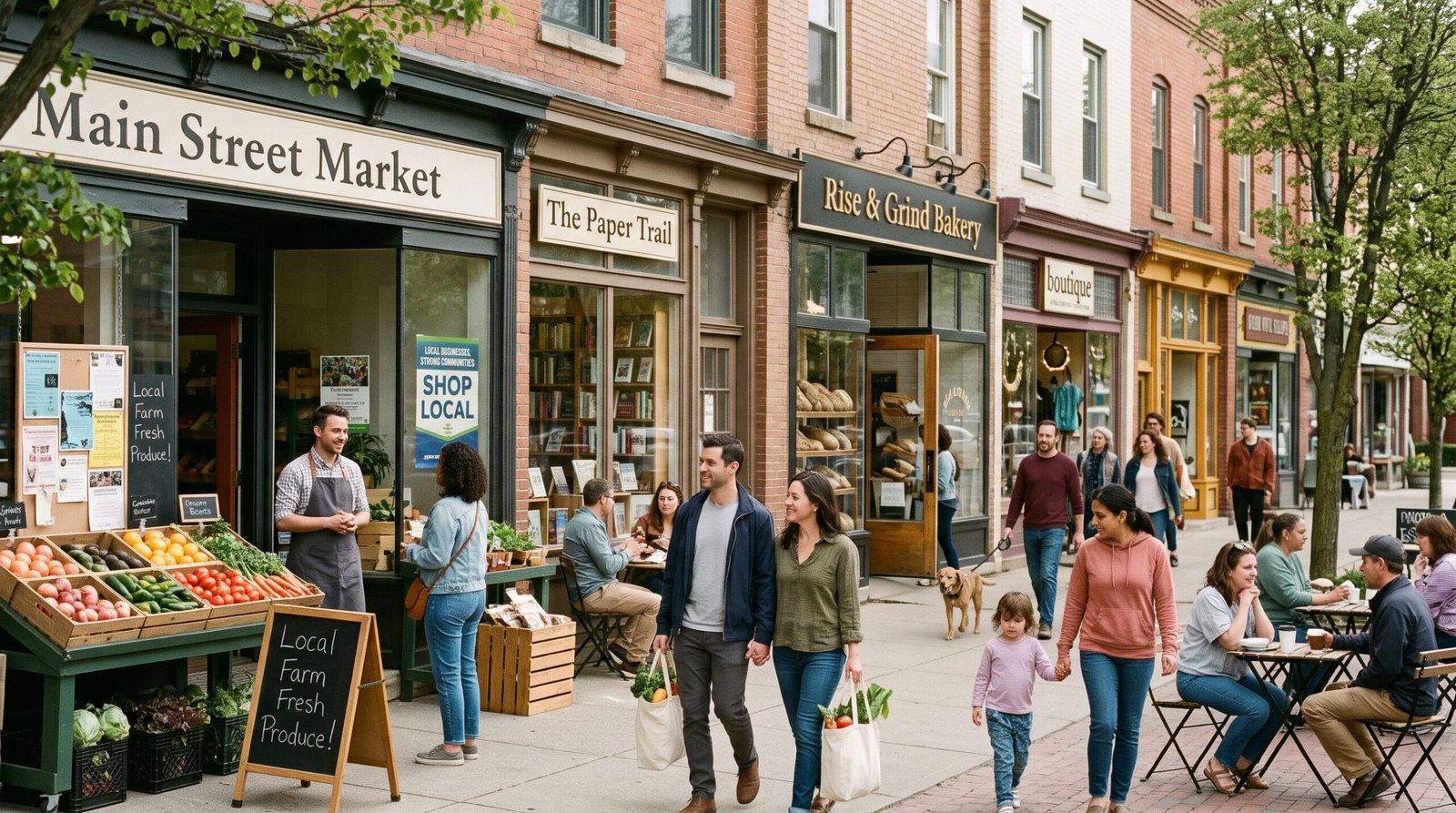
Every few months, someone at a town hall meeting asks me about shop local benefits. Usually, they have their arms crossed. “Does it actually matter where I buy my coffee?”
Honestly, I don’t mind the skepticism. In fact, it’s healthy. I’ve spent years working through county data, sitting with chamber boards, and arguing with fellow economists over regional models. So my answer is yes, it matters. However, the effect is smaller than the bumper stickers claim and bigger than most people think.
That’s the frame I want to use here. The shop local benefits for a community are real, measurable, and sometimes surprising. Of course, they aren’t magic. Nor do they mean you should never set foot in a chain store again. Instead, they mean that every purchase carries economic weight beyond the receipt. Where that weight lands depends on who owns the business behind the counter.
So let’s go through what the research shows, where it’s strong, where it’s thinner, and what it means for your town.
Why Shop Local Benefits Depend on Where the Money Goes Next
Most people judge a purchase by the first transaction. For example, you hand over twenty dollars and get a book. Done.
Economists, on the other hand, care about the second, third, and fourth transactions. After all, that’s where a local economy either grows or leaks.
When you buy from an independent retailer, a meaningful share of that money gets spent again nearby. First, the owner pays local staff and hires a local accountant. Next, they advertise in the local paper and buy supplies from a regional distributor. Finally, they bank with a community lender and take their profit home to the same town. Each payment then becomes someone else’s income, and part of it gets spent locally again.
A chain store also employs local people, and that matters. But a bigger slice of its revenue goes straight back to headquarters. Specifically, it pays for corporate accounting, marketing, inventory systems, legal work, and shareholder returns. That money doesn’t vanish from the national economy. Still, it leaves your county.
Economists call the difference the local multiplier, and it sits at the heart of most shop local benefits. Similarly, the American Independent Business Alliance explains the local multiplier as the result of independent owners spending more of their revenue locally than chains and online giants do.
What the Multiplier Studies Actually Found
The most widely cited work here comes from Civic Economics. This private research firm has run local return studies across North America for about two decades. Their approach is simple. First, they survey independent businesses about where their money goes. Then they compare that with the public filings of national chains in the same categories.
The Andersonville Numbers on Shop Local Benefits
One of the best known studies looked at Chicago’s Andersonville neighborhood. According to the Institute for Local Self Reliance summary of the Andersonville study, the gap was clear. Spending $100 at a neighborhood independent generated $68 in additional local activity. By contrast, the same $100 at a chain produced only $43.
Part of that gap was payroll. Independents spent 29 percent of revenue on local labor, while chains spent 23 percent. Why? Because management, bookkeeping, and buying happened on site instead of at a corporate office.
That point gets overlooked. In other words, shop local benefits don’t come from local owners being nicer people. Rather, they come from structure. When management, design, accounting, and marketing are handled by people who live nearby, those wages stay nearby too.
Salt Lake City and the National Series
Salt Lake City tells a similar story. KSL’s report on the Local First Utah study found independent retailers returned about 52 percent of revenue to the community. In comparison, the chains analyzed returned about 14 percent.
Then there’s the broader series. The American Booksellers Association’s Indie Impact national summary combined ten local studies. Together, they covered places as different as Las Vegas, New Mexico, and Louisville, Kentucky. Even so, the result held in big cities and small towns alike. Independents consistently recirculate a much larger share of revenue locally than chains do.
A Word of Caution From Inside the Profession
I’d be doing you a disservice if I shared those numbers without context. Several of these studies were commissioned by buy local alliances or independent business groups. That doesn’t make them wrong, and the methods are fairly transparent. Still, sample sizes are often modest, and businesses report their own spending. Meanwhile, chain figures come from annual reports that don’t break spending down by town.
I also want to be clear about what the multiplier leaves out. If a chain sells the same item for less, for instance, the shopper keeps the difference. Some of that saving gets spent locally too. Therefore, any honest look at shop local benefits has to weigh it.
Even with those caveats, the direction of the finding hasn’t changed in twenty years. Granted, the size of the gap moves around. Yet the gap itself keeps showing up. When a result holds across different researchers, regions, and decades, economists take it seriously.
Shop Local Benefits Start With Jobs
If the multiplier is the engine, employment is the fuel. Indeed, small firms are the backbone of job creation in the United States. That’s not advocacy talking. Instead, it’s federal data.
The SBA Office of Advocacy’s Frequently Asked Questions About Small Business 2026 covers January 1995 through December 2024. Over that period, small businesses created 20.7 million net new jobs. Large businesses, meanwhile, created 13.2 million. As a result, small firms produced about 61 percent of net new job creation.
More recent numbers are even more striking. The SBA’s 2025 Small Business Profiles release looked at March 2023 to March 2024. During that year, small businesses created roughly 9 of every 10 net new jobs in the country.
Why Rural Towns Feel Shop Local Benefits Most
Small businesses matter even more outside big metro areas. For example, the SBA Office of Advocacy’s 250 Years infographic counts 36.2 million small businesses nationwide. Overall, they account for about 45.9 percent of total employment. In rural areas, however, that share rises to 56.6 percent.
That last number comes up constantly when I work with rural county commissions. In a town of six thousand, the hardware store, diner, insurance agency, and pharmacy aren’t side features. Quite simply, they are the economy. Consequently, losing two or three of them can change the job picture for an entire school district.
One nuance is worth keeping in mind. Not every small business is locally owned, and the reverse is also true. A franchise location, for instance, is often small on paper while sending fees and supply purchases to a national parent. So the strongest shop local benefits appear where ownership and decision making both sit in the community.
The Tax Base Side of Shop Local Benefits
This is where I see city managers sit up a little straighter.
Local governments mostly run on property and sales taxes. For decades, therefore, the standard playbook was to court large retail developments at the edge of town. After all, they promised big sales tax numbers. Unfortunately, that approach often ignored how much land those projects consume and how much infrastructure they need.
Measuring Revenue per Acre
Joe Minicozzi of Urban3 changed how many planners think about this. Specifically, he measured tax revenue per acre instead of per project. The ILSR guide on why independent businesses matter summarizes his sample of 30 cities in 10 states. On average, a big box store generated about $7 in property taxes per acre. By comparison, a mixed use, mid rise business district generated about $287 per acre.
Asheville, North Carolina, where Minicozzi first ran the numbers, showed a dramatic gap. According to Planetizen’s report on the smart math of mixed use development, a typical downtown acre produced $360,000 more in city tax revenue. That’s compared with an acre of strip malls or big box stores.
What This Means for Main Street
So how does this connect to shop local benefits? Downtowns and traditional main streets are where independent businesses cluster. Small shops, upstairs offices, and family restaurants are exactly the land use that produces strong tax yield per acre. Thus, when residents keep those storefronts busy, they quietly support the most fiscally efficient part of the city.
The cost side matters just as much. Compact districts use roads, water lines, and emergency services more efficiently. In contrast, sprawling retail corridors need new interchanges and acres of parking. Naturally, a council that understands this tends to make better zoning decisions.
Shop Local Benefits for Income and Wellbeing
Beyond jobs and taxes, research also links local business ownership with broader measures of prosperity.
Anil Rupasingha at the Federal Reserve Bank of Atlanta published a study on this in 2013. It’s covered in the ILSR overview of local ownership research. Counties with more locally owned small businesses had stronger per capita income growth. In addition, they had faster employment growth and lower poverty rates. Likewise, separate international work found that areas with more small and mid sized firms tended to have lower income inequality.
I want to be careful here, because correlation isn’t causation. Prosperous places, for example, may simply attract more entrepreneurs. Even so, researchers have tried to control for those factors, and the relationship keeps holding.
My working interpretation is simple. Essentially, local ownership spreads economic decisions across many households instead of a few distant boardrooms. So when more residents own a town’s productive assets, more of its wealth stays with the people who live there.
The Talent Retention Effect
There’s also a talent effect. Margaret Fitzgerald and colleagues studied this in the Journal of Small Business Management, as ILSR also summarizes. Notably, they found that independent retailers help communities keep residents, especially college graduates.
For regions worried about brain drain, that’s one of the most overlooked shop local benefits. Young people stay where there’s something worth staying for. Above all, a lively commercial district they can join or start a business in is part of that.
Shop Local Benefits for Civic Life
Economists don’t always like this part, because it’s hard to fit into a spreadsheet. Nevertheless, some of the oldest and most interesting research in the field is about civic life.
Lessons From the 1940s
In the 1940s, anthropologist Walter Goldschmidt compared two California farm towns. Dinuba was surrounded by small family farms, whereas Arvin was dominated by large agribusiness. Grist’s piece on locally owned businesses and community resilience recounts what he found. Dinuba had twice as many community organizations and twice as many newspapers. Its residents were also noticeably more engaged.
Around the same time, sociologists C. Wright Mills and Melville Ulmer studied pairs of Midwest manufacturing cities for a congressional committee. ILSR’s review of research on local economies and civic engagement describes the results. Cities built around small, locally owned firms beat those dominated by absentee owners on more than 30 measures of wellbeing. These included literacy, park acreage, poverty, and civic membership.
What Modern Research Adds
Modern researchers have since picked up the thread. In 2006, sociologists Troy Blanchard and Todd Matthews published a study in Social Forces. Counties dominated by a few large firms had lower social capital and less civic engagement. Meanwhile, counties with activity spread across many local businesses did better.
Later, a study led by Blanchard appeared in the Cambridge Journal of Regions, Economy and Society. It connected a strong small business presence with better public health outcomes. Both studies are discussed in ILSR’s article on local ownership and community health.
Why Ownership Shapes Civic Life
Why would ownership affect civic life? Think about who sits on the library board and sponsors the Little League team. Consider, too, who organizes the holiday parade and shows up at zoning hearings. Often, it’s the local business owner. Because their success depends on the town’s health, they have every reason to invest time in it. A district manager overseeing forty stores across three states, however, simply can’t play that role.
Political scientists Jill Clark and Matthew Record add a useful refinement. Their 2017 paper in Public Administration Review is titled Local Capitalism and Civic Engagement. In it, they studied “locally facing” firms, meaning businesses that deliberately interact with local customers and other local businesses. These firms were linked with higher civic and political engagement than local firms that mainly sell elsewhere.
Put plainly, the corner shop that knows customers by name seems to do more for civic life. Shopping local, then, strengthens exactly the kind of business that research says builds community.
Shop Local Benefits for the Environment
The environmental argument often comes with good intentions and weak evidence. For that reason, I’ll stick to what’s documented.
Lawrence Frank and colleagues studied 3,200 households in King County, Washington. Residents of neighborhoods with the most local businesses drove 26 percent fewer miles. Moreover, they were much more likely to take transit to work. The finding appears in the ILSR research roundup on local businesses.
The mechanism is simple. Neighborhood shops shorten trips. If you can walk four blocks for groceries, you skip the fifteen minute drive to a regional power center. Fewer miles mean less congestion, less road wear, and lower emissions. On top of that, these shop local benefits include real household savings on fuel, which tends to get spent locally.
What the Big Spending Days Tell Us
American Express created Small Business Saturday in 2010, and the SBA has cosponsored it since 2011. Since then, it’s become an annual gauge of interest in shopping local. According to NBC News coverage of Small Business Saturday, consumers spent about $22 billion on the day in 2024. Small business owners also estimated nearly 20 percent of their annual revenue would come from the event.
Additionally, the American Express Shop Small program page cites its 2025 Small Business Economic Impact Study, conducted by Econsult Solutions. It estimates that 68 cents of every dollar spent at a small business stays in the local community.
I have two professional notes on these figures. First, spending totals come from surveys of what shoppers say they spent, not actual receipts. American Express says so openly. Second, the company has a clear commercial interest in the event. For both reasons, I treat these numbers as signals of direction and scale, not precise measurements.
The bigger lesson isn’t in one day’s total. A business earning a fifth of its revenue in one weekend is fragile. Ultimately, the communities that enjoy lasting shop local benefits support local businesses steadily all year, not just once.
Shop Local Benefits Still Apply Online
Here’s a point I wish more buy local campaigns made. Shopping local isn’t the opposite of shopping online.
Many independent retailers now run their own online stores. Some also take orders through social channels and offer curbside pickup or local delivery. So when you buy from your hometown bike shop’s website, the local multiplier still applies. The owner, the staff, and the profit all stay in the same county.
What matters is ownership and where the money circulates. By comparison, whether you buy at a counter or a checkout page makes little difference. For independent retailers, a solid online storefront can decide whether they survive a slow season. For shoppers, meanwhile, it removes the convenience excuse. As a result, you get the ease of online shopping along with the same shop local benefits.
I’d encourage local business owners to put real effort in here. Customers increasingly start their search online, even for purchases they make in person. Therefore, a shop that can’t be found, can’t show inventory, or can’t take orders after hours is losing ground for no reason. The same goes for a thin Google Business Profile, missing directory listings, or a page with too few reviews and unanswered complaints.
How to Capture Shop Local Benefits on Any Budget
I never tell people to boycott chains or overpay out of principle. That isn’t realistic for most budgets, and besides, the evidence doesn’t call for it. Instead, the research points to something more modest. Shift part of your spending.
The Maine Center for Economic Policy ran a 2011 analysis on this, summarized on Loyola University Chicago’s buy local research page. It modeled what would happen if Portland area residents moved 10 percent of their spending from chains to local businesses. The result was a meaningful rise in regional activity and jobs. Not 100 percent, but just ten.
Here’s how I suggest people approach it:
- Start with services. Accountants, dentists, mechanics, insurance agents, and home repair are often already local. Keep them that way. Service spending has a strong multiplier because most of the cost is local labor.
- Pick one or two categories you care about. Books, coffee, hardware, gifts, or restaurants all work. Then make those your local defaults and don’t stress about the rest.
- Buy gifts locally. Gift spending is flexible and concentrated around the holidays. Consequently, shifting it moves a lot of money at once.
- Use local businesses’ online options. If convenience pulls you toward national platforms, check whether your local shop sells online or offers pickup.
- Talk about it. Word of mouth is still a small business’s most powerful marketing, and it costs you nothing. Leaving an honest online review counts too.
The Bottom Line From an Economist’s Desk
After years of studying this question, here’s where I come out. The shop local benefits for your community show up in five places. To begin with, more money recirculates locally. A larger share of new jobs also appears. Beyond that, the tax base gets stronger per acre. Income and wellbeing measures improve as well. Finally, civic life gets richer. The evidence is strong in some areas and still developing in others, but the pattern is consistent.
None of this requires giving up every chain or paying more for everything. Rather, it asks you to recognize that your spending has a second life after it leaves your hands. Send some of it where that second life does the most good for the place you call home.
So the next time someone asks whether shop local benefits are real, I’ll still say yes. And now you know why.
Frequently Asked Questions
What are the main shop local benefits for a community?
The biggest benefit is a stronger local multiplier, meaning more of each dollar gets spent again nearby. In addition, shopping local supports more jobs, a more productive tax base, and stronger civic involvement. Research summarized by the Institute for Local Self Reliance also links local ownership with higher income growth and better public health.
How much more money stays local when I shop at an independent business?
It depends on the town and the type of business. In Chicago’s Andersonville neighborhood, for example, $100 at an independent generated $68 in local activity versus $43 at a chain, according to ILSR’s summary of the study. Similarly, in Salt Lake City, independents returned about 52 percent of revenue locally, compared with about 14 percent for chains, as KSL reported.
Do small businesses really create most new jobs?
Yes. The SBA Office of Advocacy reports small businesses created about 61 percent of net new jobs from 1995 to 2024. More recently, the 2025 SBA profiles show they created about 9 of every 10 net new jobs from March 2023 to March 2024.
Is a local franchise the same as a locally owned business?
Not quite. Although a franchise may have a local owner, it usually sends royalties, fees, and supply purchases to a national parent. As a result, the local multiplier is lower than for a fully independent business. The American Independent Business Alliance explains how ownership shapes where revenue goes.
Do shop local benefits still count when I buy online?
Yes, because the benefit comes from who owns the business and where its revenue circulates. Buying online from a local retailer therefore still supports local payroll, local suppliers, and local profits.
Why do local businesses matter for city tax revenue?
Independent businesses tend to cluster in compact downtowns and main streets. Those areas, in turn, produce far more tax revenue per acre than sprawling retail. Urban3’s research, reported by Planetizen, found downtown Asheville land yielded $360,000 more per acre than strip malls or big box stores.
How can I support local businesses if I’m on a tight budget?
Shift a small share of your spending, not all of it. Modeling from the Maine Center for Economic Policy, summarized by Loyola University Chicago, showed real regional gains from moving just 10 percent of spending. So start with services, gifts, or one category you already enjoy.
References
- Institute for Local Self Reliance. The Andersonville Study of Retail Economics
- American Independent Business Alliance. What Do We Mean by the Local Multiplier?
- American Booksellers Association. Indie Impact National Summary: Indies Give Back Over Three Times as Much as Chains
- KSL. The Case for a Local First Mentality
- SBA Office of Advocacy. Frequently Asked Questions About Small Business 2026
- SBA Office of Advocacy. New Advocacy Report Shows the Number of Small Businesses in the U.S. Exceeds 36 Million
- SBA Office of Advocacy. Celebrating 250 Years Small Business Infographic
- Institute for Local Self Reliance. Why Care About Independent, Locally Owned Businesses?
- Institute for Local Self Reliance. Local Economies and Civic Engagement Research
- Institute for Local Self Reliance. Local Ownership and Community Health
- Institute for Local Self Reliance. Key Studies: Why Independent Matters
- Planetizen. The Smart Math of Mixed Use Development
- Grist. Locally Owned Businesses Can Help Communities Thrive and Survive Climate Change
- Clark, J. K. and Record, M. Public Administration Review. Local Capitalism and Civic Engagement: The Potential of Locally Facing Firms
- NBC News. Today Is Small Business Saturday: How to Shop and Support
- American Express. Shop Small and the 2025 Small Business Economic Impact Study
- Loyola University Chicago. Buy Local Research and Economic Impact Studies