
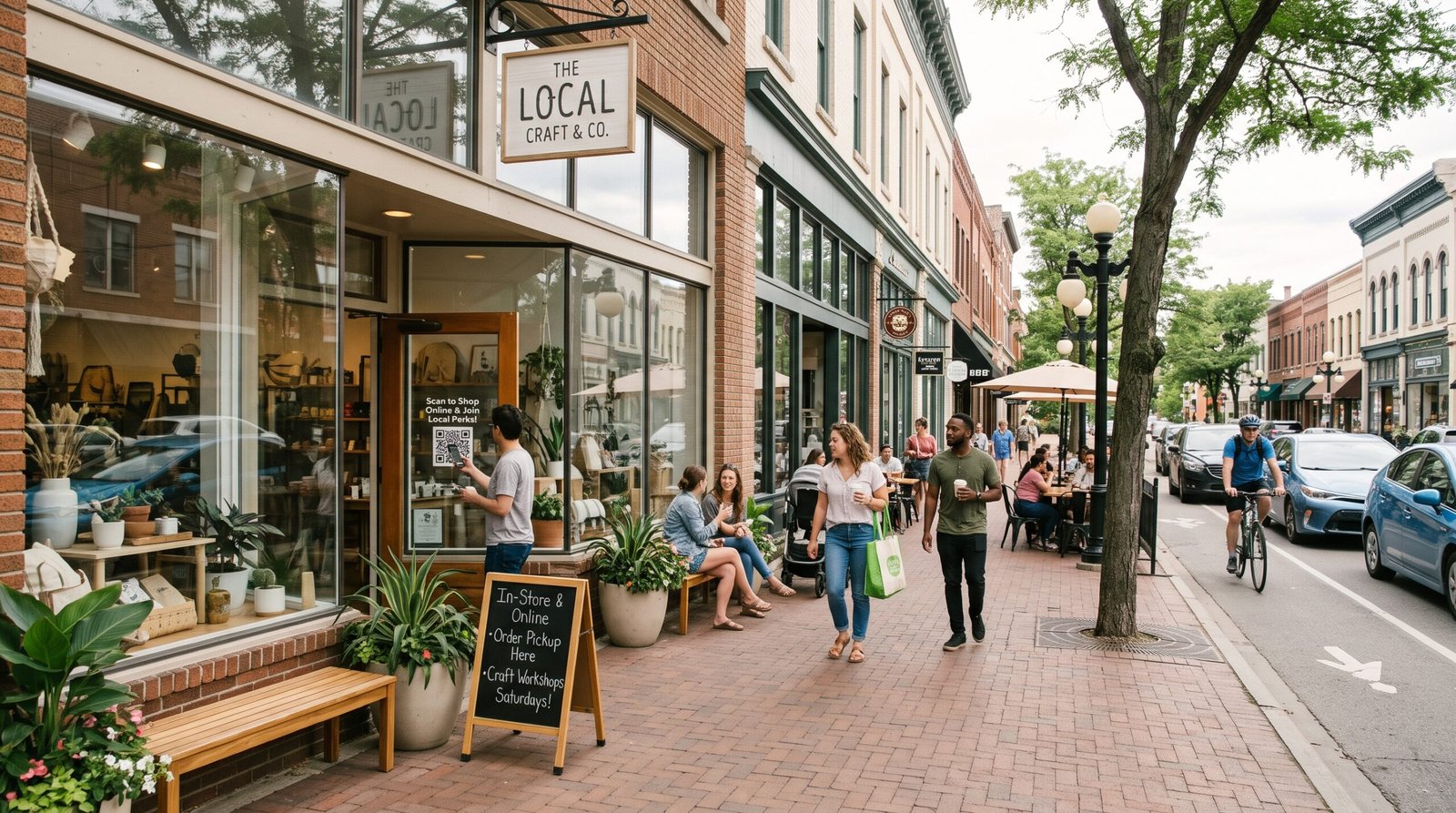
Local Retail Store Trends Shaping Main Street Shopping
I spend a lot of time walking downtowns, because that’s where local retail store trends show up long before they reach a quarterly report. Not malls, not power centers, but the four to twelve block stretches with a hardware store, a bookshop, two coffee places that pretend not to compete, and a boutique whose owner knows half her customers by their dog’s name. When I first started tracking these districts, the forecast for them was grim. Ecommerce would hollow them out, and then chains would finish the job.
However, that isn’t what happened. In fact, if you look closely at the local retail store trends unfolding right now, Main Street is doing something more interesting than surviving. It’s changing what a store is for.
This piece is my attempt to lay out what I’m seeing in the data and on the sidewalk, without the hype in either direction. Some of the news is good, while some of it is uncomfortable. Still, all of it matters if you run, lease to, build for, or simply care about a local store.
The Numbers Behind Local Retail Store Trends
Every conversation about Main Street eventually runs into the same question: isn’t online shopping eating everything? The honest answer is that it’s eating steadily, but slowly.
What the Census Data Actually Says
According to the U.S. Census Bureau’s Quarterly Retail E-Commerce Sales report, ecommerce accounted for 17.1 percent of total U.S. retail sales in the second quarter of 2026, seasonally adjusted. Meanwhile, online sales grew 12.2 percent year over year while total retail grew 6.7 percent. That gap is real, so nobody should wave it away.
But flip the number around. Roughly 83 cents of every retail dollar still moves through channels other than ecommerce. Moreover, the online share crept up less than one percentage point across a full year, as the Federal Reserve Bank of St. Louis FRED series shows quarter by quarter. That’s not a collapse. Instead, it’s erosion at a pace a smart operator can plan around. The next Census reading for the third quarter is due out on November 19, and I’d be surprised if it changes the shape of the story.
Store Closures Have Cooled
The store count tells a similar tale. Retail TouchPoints, citing Coresight Research, reported 3,321 U.S. store closures at midyear 2026, down 44.1 percent from the same point in 2025. As a result, the net store loss shrank from 1,765 to just 106. Retail bankruptcies also dropped from 32 to 10 over the same window.
In other words, the great shakeout has mostly shaken out. What’s left is a retail map that’s being redrawn deliberately rather than torn up in a panic. That’s the backdrop for every one of the local retail store trends below.
Fewer Visits and Bigger Baskets Lead Local Retail Store Trends
If I had to pick the single most important pattern for local stores in 2026, it would be this one. People are coming in less often, but when they come, they spend more per trip.
The Transaction Data
The Fiserv Small Business Index has been documenting this for months. In its April reading, for example, small business sales rose 1.1 percent year over year, carried by average tickets that climbed 2.8 percent, while transactions fell 1.7 percent. By July, small business foot traffic overall had declined for nine consecutive months. Furthermore, once you adjusted for inflation, headline sales were down 1.8 percent.
Retail itself held up a little better. Fiserv’s retail sector reading for July showed sales up 1.9 percent year over year and transactions up 2.2 percent. So the picture isn’t uniform. Stores that sell things people need, or things people genuinely want to hold before they buy, are keeping their traffic. Discretionary trips, on the other hand, are the ones getting cut.
What It Looks Like on the Sidewalk
On the ground, this shows up as a customer who used to stop by three times a month now coming once, with a list. You also see quieter Tuesday afternoons and busier Saturday mornings. One kitchen supply shop owner told me she had stopped measuring success by how many people walked in. Instead, she now measures how many walk out with two or more items.
The Main Street America small business survey covered by NPR Illinois captured the pressure behind this shift. Nearly 1,300 small business owners responded, and 45 percent said their net profit dropped that fall. One Iowa market owner put the real problem plainly: “we really need the people there to come every week.”
That’s the tension. Main Street can’t run on one big shopping day, because it runs on habit. Therefore, this isn’t just one of those local retail store trends about bigger baskets. It’s that the stores which win are the ones that give people a reason to come back before the list fills up.
Small Towns Are Outrunning Big Cities in Local Retail Store Trends
This one surprises people at dinner parties, so I’ll lay it out carefully.
What the Faire Report Found
In July 2026, wholesale marketplace Faire released its inaugural Independent Retail Report, drawing on a panel of more than 130,000 retailers active in both the second quarter of 2025 and the second quarter of 2026. As Chain Store Age summarized, the report found that physical stores are outgrowing online only sellers and that small towns are outpacing major cities. Additionally, Retail TouchPoints reported that 59 percent of Faire’s brick and mortar retailers globally said their wholesale purchasing grew in the quarter. Small cities and towns beat New York, London and their equivalents in nearly every country measured.
I want to be careful here, though. Faire’s panel is Faire’s customers, which skews toward gift, home, apparel, and specialty goods. It’s not the whole universe of local retail. Even so, the direction lines up with what I see elsewhere.
Why Local Retail Store Trends Favor Smaller Markets
Why would a town of 30,000 outperform a global city? A few reasons keep coming up when I talk to owners.
First, there’s rent. A smaller rent bill gives an owner room to experiment, carry deeper inventory, or stay open later without betting the business.
Second, hybrid work plays a quieter role. People who used to spend their weekday lunch hour downtown in a big city now spend it near home. Consequently, their neighborhood main street picked up spending that used to go to a central business district.
Finally, there’s competition. In a big metro, an independent shop competes with a hundred other options within a short walk. In a small town, by contrast, a well run shop becomes the default. Being the obvious choice is a strategic advantage that’s hard to copy.
If you’re a landlord, a downtown director, or a developer, these local retail store trends should change where you look for tenants and how you talk to them. The independent operator is no longer the fallback tenant. Indeed, in many smaller markets, it’s the growth tenant.
Curation Is an Early Warning System for Local Retail Store Trends
Here’s a detail from the Faire report that I keep telling clients about. Independent retailers began stocking squishy toys roughly six weeks before mainstream press and big box stores caught on. Similarly, the same pattern showed up with Mahjong sets and Dubai chocolate, according to Gifts and Decorative Accessories’ coverage.
Six weeks is a long time in retail. After all, it’s the difference between selling something at full price and marking it down while everyone else catches up.
Why Small Buyers Spot Trends First
So how does a three person shop beat a national merchandising team? Proximity. The owner hears what customers ask for and sees what teenagers photograph. She also notices when three different people in one week ask whether she carries something. While a chain buyer reads a dashboard, an independent buyer reads a room.
Faire’s chief revenue officer, Jennifer Burke, framed inventory as the expression of independents’ “biggest advantage: taste.” I’d go a step further, because taste is the product. People don’t drive to a local shop for a commodity they can get delivered tomorrow. Rather, they drive there to see what someone with a point of view decided was worth their shelf space.
Self Expression Is Driving Local Retail Store Trends
The 2026 Faire Forecast leaned into the same idea, naming four themes for the year: Well Read, Fan Fare, More is More, and Witching Hour. Underneath all four is the same consumer instinct. Shoppers are tired of algorithmic sameness, so they’re buying things that say something about who they are.
For local retail, that’s an open door, and it may be the most hopeful of all the local retail store trends I follow. Algorithms are great at showing you more of what you already bought. However, they’re terrible at surprising you. A good store, on the other hand, is a surprise you can walk into.
The Store as a Brand Stage in Local Retail Store Trends
For years, retailers justified stores with one metric: conversion. Did people come in and buy? That’s still important, but it’s no longer the main reason companies are investing in physical space.
Why Retailers Are Investing in Stores
Retail Brew’s State of Stores report found that close to 78 percent of retailers surveyed reported moderate or significant investment in their physical locations. More telling were the reasons. Sixty two percent said they were investing to strengthen brand perception, and 58 percent to boost loyalty, both ahead of conversion goals. The same report also noted Dollar General’s plan for 4,700 real estate projects in 2026, covering both openings and remodels.
When a dollar store chain and a direct to consumer apparel brand both say stores matter, you’re looking at a consensus, not a fad.
What It Means for Independents
So what does this mean for a local, single location store? Essentially, the bigger players are now competing on the same turf where independents have always lived: atmosphere, familiarity, and feeling known. That’s both validation and a warning. The chains have bigger budgets for lighting, fixtures, and events. Therefore, the independent’s edge has to come from the things money doesn’t buy easily, such as real relationships, local knowledge, and product that doesn’t show up in every other town.
I often ask owners a simple question: if a customer walked in, bought nothing, and left, would they still tell a friend about the visit? If the answer is yes, the store is doing its job as a brand stage. If not, the store is a warehouse with a front door, and warehouses lose to delivery trucks every time.
AI Shopping Agents Are Reshaping Local Retail Store Trends
This is where I put on the futurist hat, because the shift is just getting started.
Shoppers Are Handing Decisions to AI
Deloitte’s retail and consumer trends research describes retail moving away from shoppers manually searching and comparing products toward shoppers delegating those decisions to AI assistants. If you’ve asked a chatbot which running shoes to buy or which coffee grinder is worth the money, you’ve already felt this.
The intuitive reading is that AI pushes even more spending online. In some categories, it certainly will. Nevertheless, I think the more important effect is that it raises the value of whatever an AI can’t do for you. A chatbot won’t let you feel the weight of a cast iron pan. Nor will it let your kid try three bikes in a parking lot. And no algorithm can introduce you to the person who’ll fix that bike in six months.
Digital Tools Inside the Store Raise the Basket
Retail Brew made this case directly in its reporting, arguing that AI is making physical stores more important, not less. For instance, Walmart told Retail Brew that shoppers who used its AI powered app inside stores were spending 25 percent more on average. That’s a giant chain, yet the lesson scales down: digital tools that help people inside the store tend to raise the basket.
There’s also a gap worth noticing. In Placer.ai’s survey of nearly 500 retail leaders, only 30 percent said stores excel at inspiring shoppers to discover new products. Think about that. Discovery is the thing an AI agent is worst at replicating, and yet most retailers admit they aren’t great at it.
Getting Found by Shopping Assistants
For local stores, then, the practical move is to make sure AI tools can find you in the first place. Suppose a shopping assistant is asked “where can I buy a quality chef’s knife near me today.” In that case, it will lean on whatever structured, current information it can read. Accurate store hours, a real product catalog online, visible local inventory, and a well maintained business profile are no longer nice extras. Instead, they’re how a local store gets into the conversation before the customer ever leaves the couch.
Friction Is the New Price War in Local Retail Store Trends
Ask most owners why customers leave, and they’ll say price. The research, however, is saying something different.
Crowds and Empty Shelves Drive Shoppers Away
Sogolytics’ State of In Store Retail CX study, based on a survey of 951 U.S. adults fielded in August 2026, found that crowds, not prices, were the top reason shoppers skipped stores this season. It also found that product problems create about twice as much friction as staff problems. Specifically, 28 percent of shoppers reported product availability or access issues, compared with 14 percent who reported issues with employees.
The age split was striking, too. Shoppers aged 18 to 24 reported a negative outcome on 45 percent of their store visits, nearly double the 24 percent rate for shoppers 65 and older.
An Opening for Small Stores
I read this as both a problem and an opening for local retail. Big boxes are where crowding and “it says in stock but I can’t find it” frustration tend to happen. A small store, done right, is the opposite experience. You can see the whole floor, and someone can tell you in five seconds whether the thing is in the back.
But the Gen Z number should keep owners up at night. Younger shoppers aren’t anti store. In fact, Retail Brew quoted store designer Melissa Gonzalez saying Gen Z and Gen Alpha want community, engagement, and something tactile. They’re simply less forgiving. One empty shelf, one confusing layout, or one awkward checkout, and they’re out. Consequently, the local stores that win the next decade will treat friction like a cost line, not an annoyance.
A Flatter Holiday Calendar Is Changing Local Retail Store Trends
For a long time, Main Street’s year hinged on a single weekend after Thanksgiving. That’s now loosening, and it’s one of the local retail store trends owners feel most directly in their cash flow.
Shoppers Are Spreading Out Their Spending
The CNBC and SurveyMonkey 2025 Small Business Saturday survey found that 82 percent of Americans planned to do the bulk of their holiday shopping outside Thanksgiving weekend. Only about one in four planned to shop at a small business on Small Business Saturday itself. Encouragingly, though, among those planning to shop small, 77 percent expected to do it in person, compared with 53 percent online.
Small Business Saturday still matters, of course. The U.S. Small Business Administration noted that estimated spending at local merchants on that day in 2024 was around $22 billion, based on an American Express consumer survey. Even so, it’s one day among many now, not the make or break moment it once was.
Physical Stores May Have the Edge This Season
There’s also a hint that this season may favor physical stores. Retail Brew, citing Alchemer’s 2026 holiday shopper report, said 35.8 percent of customers planned to go to physical stores to make a purchase, compared with 31.1 percent likely to shop online. Apparently, tighter budgets are pushing people to see and touch before they spend.
The takeaway for local stores, therefore, is to stop planning the holidays as a single spike. Plan instead for a long, uneven stretch from late October through New Year’s, with smaller events, early previews, and reasons to visit every week.
Civic Partnerships Are Joining Local Retail Store Trends
This is the trend that separates Main Street from almost every other corner of retail. Local stores don’t just sit in a community. They help hold it together, and increasingly, that relationship is part of the business model.
Community Giving as Marketing Infrastructure
The Main Street America survey found that 70 percent of small business owners contributed to local causes. That shows up as Little League sponsorships, fundraiser nights, and window space for the school play. It’s easy to dismiss as goodwill. Personally, I think it’s closer to marketing infrastructure.
The same reporting described how owners facing softer foot traffic are adapting. For example, some are adjusting hours, joining popup markets, and cohosting events with neighboring businesses or nonprofits to raise visibility. A Small Business Development Center consultant in Kansas described the shift in shopping habits as lasting, which is exactly why these collaborations matter. When the solo store can’t draw a crowd on its own, the block can.
The Block as a Cooperative
The best downtowns I’ve studied run like a loose cooperative. The bookstore hosts an author, the wine shop pours, the bakery sends samples, and the chamber or downtown association handles the promotion. Nobody owns the event, yet everybody benefits from the traffic. Ultimately, a national chain simply can’t replicate that, because it requires being part of a place rather than just located in it.
Turning Local Retail Store Trends Into Action
Trends are only useful if they change what you do. With that in mind, here’s how I’d translate these local retail store trends into Monday morning actions for a typical independent shop.
Protect Every Visit
Track basket size as carefully as traffic. If visits are going to be fewer, each one has to count. So watch items per transaction and average ticket every week. Small changes in merchandising, like placing a related accessory next to the hero product, show up here first.
Give people a reason to come back before they need something. Try new arrivals on a predictable day, a monthly workshop, or a loyalty program that rewards visits, not just spending. After all, habit is the antidote to the “fewer trips” trend.
Audit friction like a stranger would. Walk in as if you’ve never been there. Is it obvious where things are? Can someone check out in under a minute? Fix the small things first, since the Sogolytics data suggests one problem does most of the damage.
Get Found and Stand Out
Make your inventory visible online. You don’t need a giant ecommerce operation. You do, however, need a clean website, accurate hours, a real product catalog, and a business profile that AI assistants and search engines can read. In short, a fast, well structured site is now part of the storefront, as much as your window display.
Lean into curation, and say so. If your selection reflects a point of view, tell people. Shelf talkers, staff picks, and short notes about why you carry something turn inventory into a story.
Think Bigger Than One Store
Plan holidays as a season, not a weekend. Spread events out and offer early previews to your regulars. Then treat Small Business Saturday as one stop on a longer route.
Join forces with the block. Talk to your neighbors and your downtown association. Together, shared events, shared promotions, and shared signage efforts multiply what any one store can do.
Where Local Retail Store Trends Are Heading
Put all of these local retail store trends side by side, and a clear picture emerges. Commodity shopping keeps drifting online, and AI will likely speed that up. Meanwhile, what stays local is everything that depends on presence: touch, taste, trust, and the feeling of being part of a place.
That’s not a consolation prize. On the contrary, it’s a sturdier business than many people realize, because it’s built on things that are hard to automate and harder to copy.
The stores that struggle will be the ones still trying to compete on selection and price against companies with warehouses the size of towns. By contrast, the stores that thrive will treat every visit as a small event and know their customers better than any algorithm could. They’ll also make themselves easy to find in a world where the first question is increasingly asked to a machine.
Main Street isn’t going back to 1995. Instead, it’s becoming something new, and in a lot of the towns I walk through, it’s quietly getting better.
Frequently Asked Questions About Local Retail Store Trends
What are the biggest local retail store trends right now?
The major patterns are fewer but larger shopping trips, independent retailers in small towns outpacing big cities, stores investing for brand and loyalty rather than conversion alone, and AI shopping assistants changing how people find products. For ongoing data, the Fiserv Small Business Index and Retail Brew’s State of Stores report are good places to track these shifts.
Is ecommerce replacing local stores?
Not at the pace many expected. Ecommerce made up 17.1 percent of U.S. retail sales in the second quarter of 2026, according to the U.S. Census Bureau. As a result, most retail spending still runs through other channels. Online keeps gaining share, but slowly, by less than one point over the past year.
Why are small town retailers growing faster than city stores?
Lower rents, hybrid work bringing weekday spending closer to home, and less direct competition all help. In addition, Faire’s Independent Retail Report, covered by Chain Store Age, found small towns outpacing major cities and physical stores outgrowing online only sellers.
How will AI shopping assistants affect Main Street businesses?
AI assistants will handle more product research and comparison, as Deloitte’s retail trends research notes. That raises the value of what AI can’t replicate, like hands on experience and personal service. However, it also means local stores need accurate, readable online information so assistants can recommend them.
Is Small Business Saturday still important for local stores?
Yes, but it’s less central than it used to be. The CNBC and SurveyMonkey survey found most shoppers plan to do the bulk of their holiday buying outside Thanksgiving weekend. Therefore, stores benefit from spreading promotions across the whole season.
What frustrates shoppers most about physical stores?
Crowding and product availability, more than price or staff. For example, the Sogolytics in store retail study found 28 percent of shoppers hit product availability problems. Younger shoppers also reported negative visits far more often than older ones.
References
- U.S. Census Bureau. Quarterly Retail E-Commerce Sales, 2nd Quarter 2026
- Federal Reserve Bank of St. Louis. E-Commerce Retail Sales as a Percent of Total Sales (FRED)
- Retail TouchPoints. Store Openings and Closures Slow in 2026 as Retailers Take Stock
- Fiserv. Fiserv Small Business Index
- NPR Illinois. Small Businesses Feel Uneasy After a Year of Slow Sales, Main Street America Survey
- Chain Store Age. Study: Here’s Where Independent Retailers Are Growing Fastest
- Retail TouchPoints. Small Towns, Squishy Toys and Tariff Resilience: The State of Independent Retail
- Gifts and Decorative Accessories. Faire’s New Data Driven Report Shows That Small Suburban Retailers Are Crushing It
- Gifts and Decorative Accessories. The 4 Trends Shaping Retail in 2026, According to Faire Forecast
- Retail Brew. The State of Stores
- Retail Brew. AI Is Making Physical Stores More Important, Not Less
- Deloitte. Retail and Consumer Trends
- Placer.ai. What’s Next for Retail in 2026: An Industry Perspective
- Retail Dive. Sogolytics In Store Retail Study: Gen Z Leaves Stores Most Unsatisfied
- SurveyMonkey. CNBC and SurveyMonkey 2025 Small Business Saturday Survey
- U.S. Small Business Administration. SBA Encourages Americans to Shop Small on Small Business Saturday
- Retail Brew. Holiday Shoppers May Head to Stores This Year, but Retailers Face Cautious Consumers